
India has launched its first integrated phygital service centre in Umri village, Madhya Pradesh, aiming to provide online services and boost rural development through digital connectivity and various essential services.

Government claims big successes in agriculture, rural roads & investment scenario.

Tomato prices have been on the boil for more than a month. Data from major cities show that the spike has been between 125 and 150 per cent at the wholesale level. Soaring vegetable prices, including tomatoes, pushed the retail inflation rate to a nine-month high of 5.49 per cent in September, according to government data. Though reports say prices are expected to come down in the next few weeks after supplies improve from Madhya Pradesh and Himachal Pradesh, how long will the respite last is anybody's guess.

'This Budget has a one-year agenda, which you can call the sprint, and the marathon is towards Viksit Bharat.'

Senior officials, including those from a central team, were present during the night-long operation and a close vigil is being maintained on further movement of locusts, Katiyar said. Two fire brigade vehicles loaded with insecticide had been deployed in all four Jhansi tehsils besides six vehicles were kept ready at the district headquarter. Ten municipal employees with two insecticide spraying machines were posted in every block.

Lightning claims more lives in India annually than any other extreme weather event. Between April and July this year alone, 1,621 people died due to lightning strikes.

IMD data shows in the 24 hours between September 1 and 2, Haryana received 806 per cent more rainfall than normal, Punjab 759 per cent, Himachal Pradesh 510 per cent, Delhi 740 per cent, Chandigarh a staggering 1,638 per cent, and Rajasthan 193 per cent.
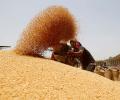
Wheat production during the current season is expected to be better than last year provided the weather remains favourable over the next few weeks, said senior industry executives. The weather had turned uncharacteristically hot in the latter half of last month, but owing to strong winds, the chill has returned in the last few days.

The India Meteorological Department (IMD) has predicted above-normal rainfall across India in June, with most parts of the country likely to experience normal to below-normal maximum temperatures. The IMD also anticipates above-normal minimum temperatures across most of the country, except for some parts of central India and the adjoining south peninsula. The southwest monsoon reached Kerala on May 24, marking its earliest arrival over the Indian mainland since 2009. The monsoon is crucial for India's agriculture-dependent economy, providing vital water for crops and supporting drinking water and hydropower generation.

Lakhs of voters will have to bear the searing heat when they step out to exercise their franchise in the second phase of the Lok Sabha elections on Friday.

Maharashtra state disaster management officials said no locust swarm was spotted in Mumbai. "The viral images and videos have been wrongly attributed as being from Mumbai," an official said.

Several BJP-backed state governments have unveiled schemes targeting the poor, women, farmers and students, following the party's setback in the Lok Sabha polls.

'The intensity and frequency of heatwaves will be much higher than in previous years over Punjab, Haryana, Rajasthan, Gujarat, Madhya Pradesh and Odisha.'
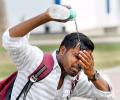
Heatwave conditions have been prevailing in Odisha since April 15 and the Gangetic West Bengal since April 17, according to the MeT department.

MP and Odisha to fine people who are found roaming outside without wearing masks. Rajasthan and Punjab pass similar orders.

Several leading scientists, academicians, and agriculturalists have called for raising government support for research and development to make Indian agriculture future-ready.
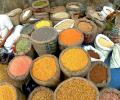
After a steady surge, prices of pulses, except those of urad and masoor to some extent, are showing signs of stabilising amid a revival of monsoon rains over major growing areas of Maharashtra and Karnataka, and on expectations of a rise in imports. Chana prices, which too had moved up in recent months, have dropped by almost 3 per cent since the end of August due to increased liquidation of government stocks, official data shows. Monsoon rains seem to have benefitted the standing soybean crop as well.

'The true measure of Project Tiger's success is not just rising tiger numbers, but our ability to ensure harmonious human-wildlife coexistence'

The south-west monsoon on Tuesday started withdrawing from parts of south-west Rajasthan and adjoining Kutch in Gujarat, with at least eight states, including rice bowl states of Uttar Pradesh and Bihar reporting deficient rains. It was for the first time since 2016 that the monsoon started withdrawing in the third week of September. "Southwest monsoon has withdrawn from parts of southwest Rajasthan & adjoining Kutch today, against its normal date of withdrawal from southwest Rajasthan of September 17," the India Meteorological Department (IMD) tweeted.
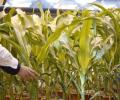
Low rain coupled with the fact that maize prices in the open market have surged from around Rs 15-16 a kg to almost Rs 25 this year have forced farmers to turn to this crop.

According to the Indian Council of Agricultural Research Director General Trilochan Mohapatra, the insects have attacked about 40,000 hectares of land.

Her immovable assets are worth over Rs 7.74 crore, which includes two inherited half shares of agricultural land in Mehrauli area of New Delhi and a half share in a farmhouse building located therein, all of which together are now worth over Rs 2.10 crore.
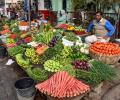
Increased production of pulses, oilseeds, and cereals will help boost domestic supplies and contribute to keeping inflation low in the coming months.

Experts said many of the programmes started in the last one year have been dogged by poor implementation, something which the state seriously needs to answer as it faces a tough electoral battle in the months ahead.

June rainfall accounts for 15 percent of the total precipitation of 87 cm recorded during the four-month monsoon season in the country.

India is set to experience extreme heat during the April to June period, with the central and western peninsular parts expected to face the worst impact, the IMD said on Monday as the country prepares for seven-phase general elections from April 19.

Yield loss due to natural calamity is calculated based on field reports and assessment of crop-cutting experiments by district and block agriculture officers.

Most key rabi-producing states of north India, such as Madhya Pradesh and Rajasthan, have staggered their procurement to enable farmers to come in batches, so that there is no overcrowding. The Centre has also set up a call centre to coordinate the inter-state movement of farm commodities.

The heat wave is likely to impact parts of Jammu and Kashmir, Himachal Pradesh, Uttarakhand, Punjab, Haryana, Delhi, Rajasthan, Madhya Pradesh, Jharkhand, Odisha and Gangetic West Bengal, the Met office said.

Though agriculture ministry officials are confident of a bumper harvest due to record increase in kharif acreage, experts and farmers said the on-ground situation in some crops is not that encouraging as incessant rains since the last few weeks and pest attack could impact the final yield.

The threshold for a heat wave is met when the maximum temperature of a weather station reaches at least 40 degrees Celsius in the plains, 37 degrees in coastal areas, and 30 degrees in hilly regions, and the departure from normal is at least 4.5 notches.

The Centre said bird flu has been confirmed so far in Kerala, Rajasthan, Madhya Pradesh, Himachal Pradesh, Haryana and Gujarat, and asked these six states to contain the disease as per the action plan.

The ravines, which are sharp, steep mud hillocks, stretch over three states - Madhya Pradesh, Rajasthan, and Uttar Pradesh, once home to several dreaded dacoits have long been the subject of several projects and government schemes to make them agriculturally viable.

Some India states are likely to record a significantly higher number of heatwave days, according to the national weather body.

Temperatures in 17 locations breached 48 degrees Celsius on Monday, with the relentless heat affecting health and livelihoods across large parts of northwestern and central India.

In a tweet, the prime minister's office said, Modi has approved an ex gratia of Rs. 2 lakh each from the Prime Minister's National Relief Fund for the kin of those who have lost their lives.

The COVID-19 pandemic, weak economic conditions, and a few political considerations are some of the challenges he faces.

There has not been a large impact of untimely rain and hailstorm so far in several major wheat-growing areas, and those might have damaged around 3 per cent of the standing crop -- not enough to make a big dent in the expected 112 million tonnes of production in FY24, a senior government official said on Tuesday. Relentless rain pounded most North Indian states all through March. Separately, the chairman of Food Corporation of India (FCI), Ashok K Meena, told reporters the agency was on track to achieve the targeted 34 million tonnes of procurement in FY24 on the back of a strong start to the purchase season from Madhya Pradesh.

Sowing up 400%; prices may be low in 2014 as Maharashtra, MP and Bengal also likely to increase acreage 15-20%.

Social stock exchange (SSE) saw its first listing on Wednesday, with SGBS Unnati Foundation becoming the first entity to take this route to avail financing. The foundation - engaged in vocational training of youth - raised Rs 1.8 crore from four investors. These include brokerage firm Zerodha and National Bank for Agriculture and Rural Development (Nabard).
 © 2026 Rediff.com - Advertise with us - Disclaimer - Privacy Policy - Sitemap - Feedback - About us - Terms of use - Grievances